AN OLD DUTCH FORT COMES ALIVE
The Galle Fort has a long history
of invaders who used this fort originally built by the Portuguese, then captured by the Dutch and lastly by the British
Protruding into the sea lie the once heavily fortified Galle Fort built in the 16 th Century and used by three different foreign invaders of Sri Lanka – the Portuguese, Dutch and the British. Declared as a World Heritage Site, it is a unique example of “an urban ensemble, which illustrates the interaction of European architecture and South Asian traditions from the 16th to the 19th centuries.” It is a World Heritage site.
Today, its cobbled narrow streets are lined with restored Dutch buildings turned into shops selling Gems and jewelry, colourful clothes, lace and antiques, interspersed among the homes of the people living there.
It is a place for everyone. Whether you want to take in the atmosphere with its many restaurants, trendy shops and buildings with colourful bougainvillea’s spilling from its balconies or just watch the golden Sun disappear into the sea while sipping a chilled beer surrounded by the smell of the sea, or if you are a history buff who wants to explore every historic building, the Galle Fort is the place for you.
Whats on this Page
Dutch Reform Church
The Dutch Warehouse
Light House
Clock Tower and the ramparts
Library
Meera Jumma Mosque
Dutch Hospital
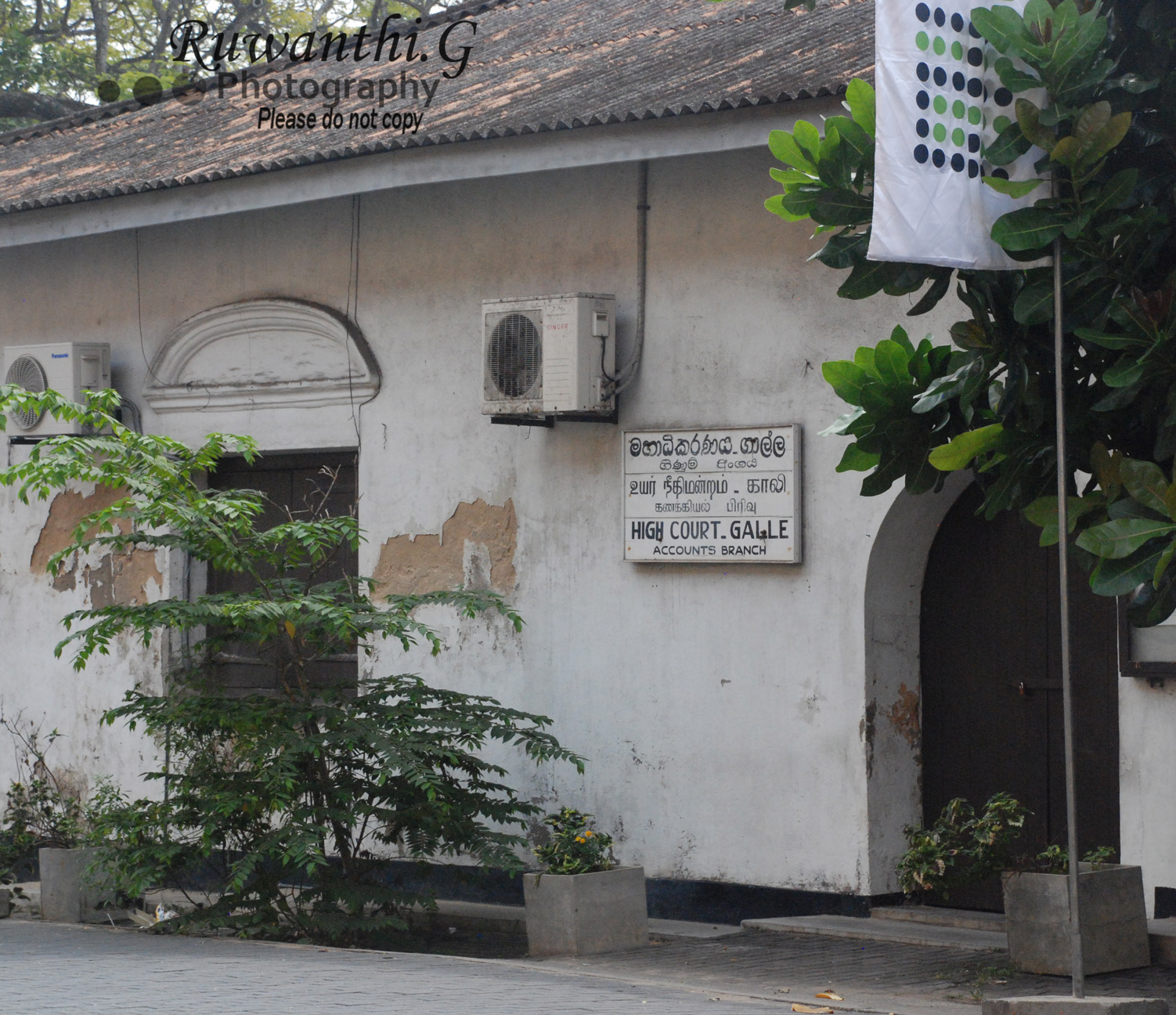
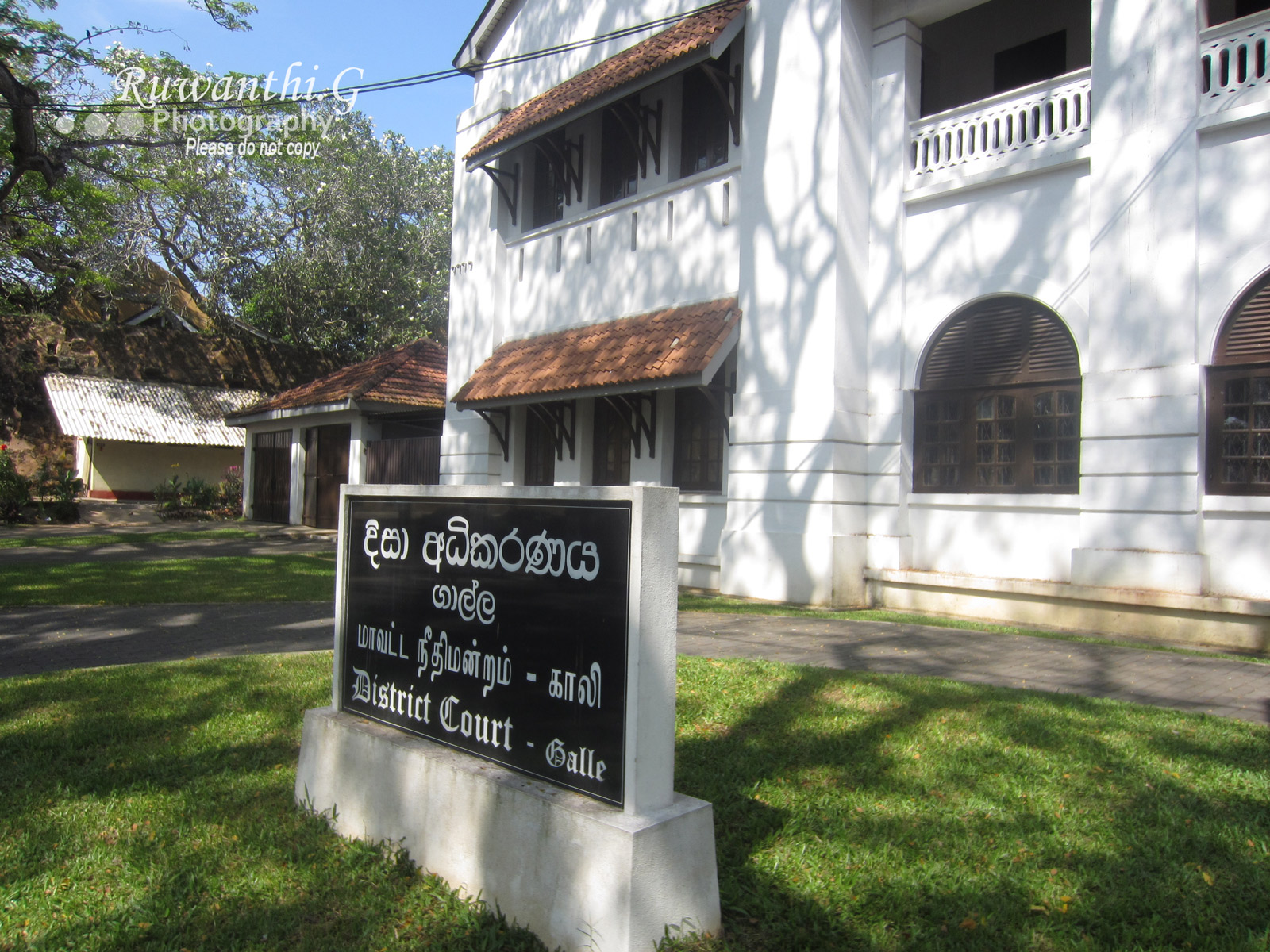
Law courts
A little bit of History


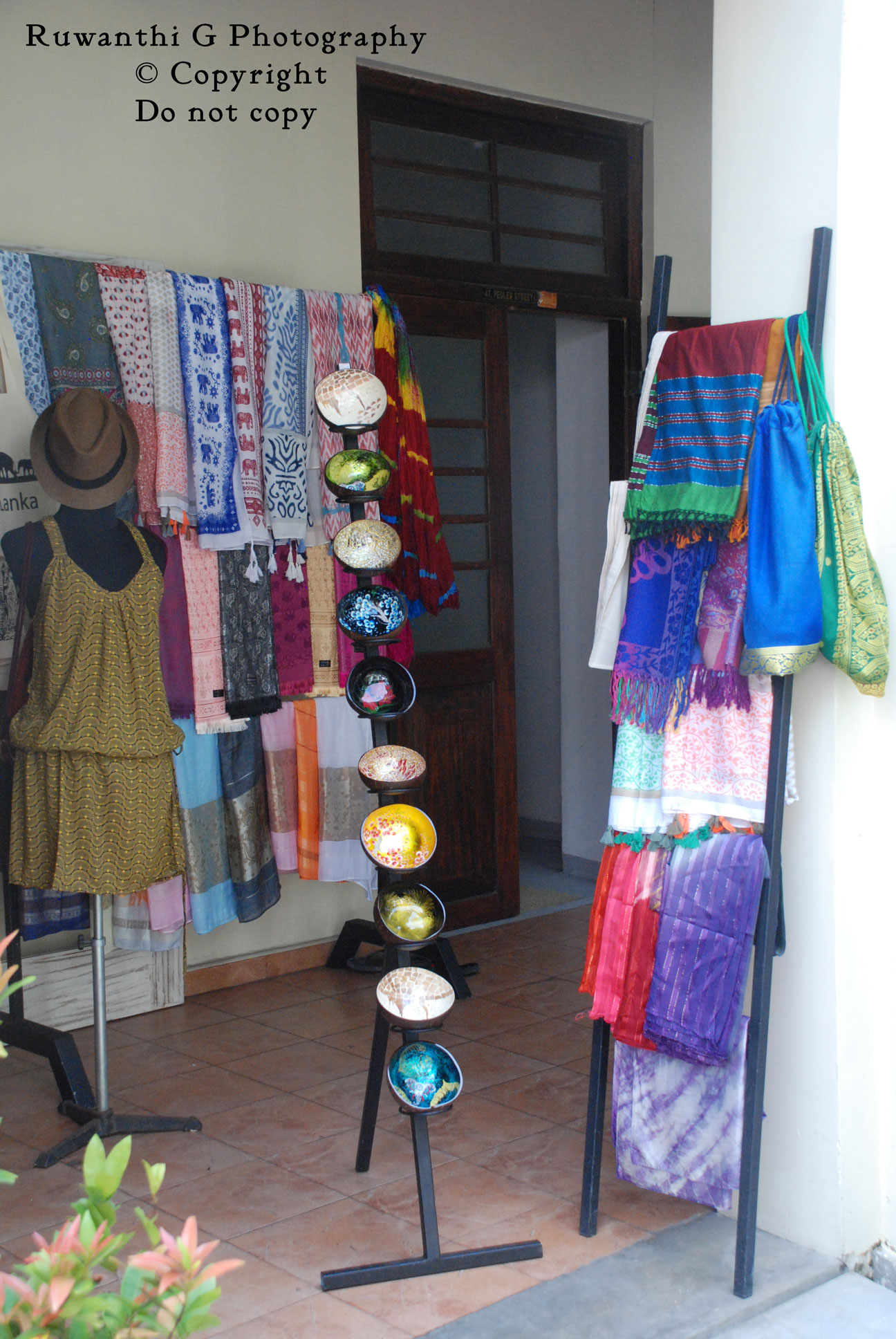
Inside the Fort is a quaint village of crisscrossing narrow paved streets and old Dutch houses now restored to its former glory. The streets were lined with a mix of houses and shops selling handicrafts and jewelry and all types of interesting things. Colourful scarves fluttered in the breeze above the woven reed baskets and floppy hats. Silver jewelry shone in the windows with sparkling Sri Lankan blue sapphires, topaz and garnets beckoning you in. The houses are airy and long, and extend to quite a distance inside. These houses have many rooms and verandahs with pillars within and many of these buildings have courtyard or garden inside filled with luscious green plants and quaint statues and old faded benches.
There are several restaurants serving various cuisines from traditional Sri Lankan fare to Mediterranean food. You can eat seated out in the garden surrounded by white frangipani flowers during the day, sheltered from the sun by an awning of branches of trees or at night lit by traditional dim brass oil lamps which accompanied by the smell of jasmines in the air makes life just perfect.
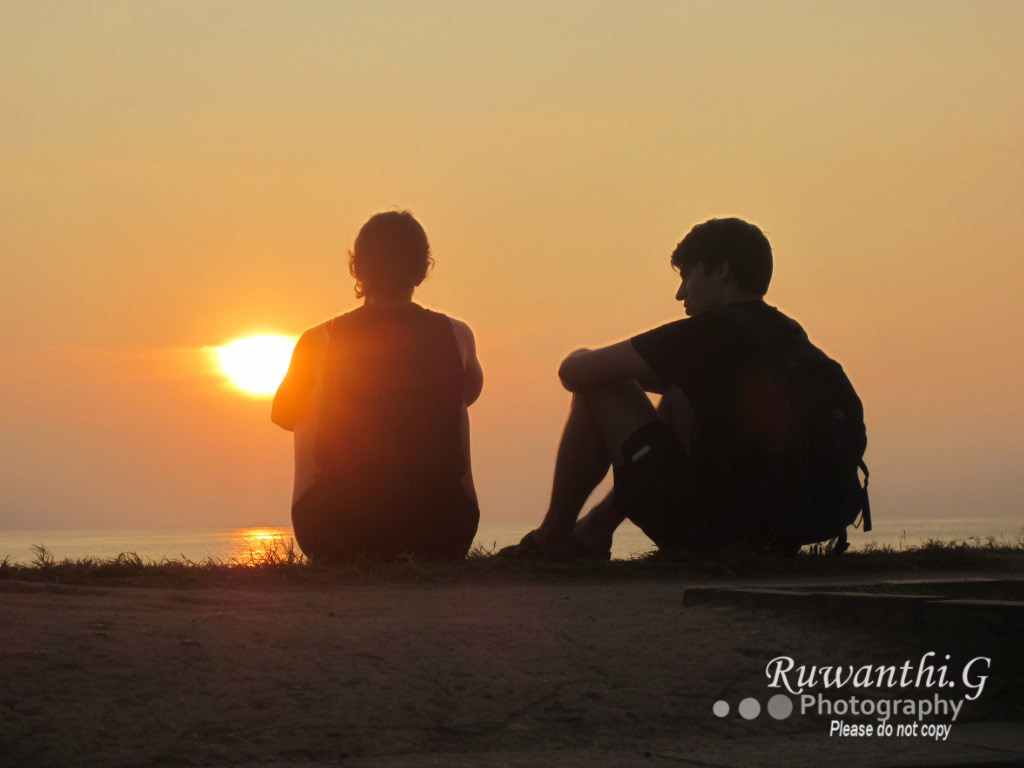
The quaint little hotels that dot the fort reflects the way in which people lived during the time the Dutch was in possession of the Galle Fort. You can sleep on an old teak wood four-poster bed surrounded by frilly mosquito nets like an ancient King or queen or bath in a bathroom with mosaic tiles of old. You could enjoy sitting on the balcony with its cascading colourful bougainvillea’s which spill over into the street below while the fresh sea air plays on your face and the huge rolling sea before you. You could get a glimpse of the sunrise and the night boats coming in with their catch of fish early morning or watching the golden sunset while sipping a cool glass of beer at the end of day.

The streets are alive with the goings-on of the day. You can watch the man who is often seated cross-legged on a low stool in the verandah of an old house cutting gemstones. He then polishes the gemstones on an old metal wheel. You watch the stone transform from a cloudy rock atop a piece of wood to a sparkling stone of great beauty and value. These are used to make many pieces of beautiful jewelry you will see in the shops in the area.

You will also find women wearing the traditional cloth and jacket with their midriff bare seated in corners of broad Verandah’s bent over a pillow-like machine with their hands flying deftly as they weave the traditional Beeraloo lace. This lace is used as trims for the edges of the blouses they wore or as edging for table linen and curtains. Beautiful, dainty and delicately woven.


At dusk I saw a group of little Muslim boys after prayers at the Mosque nearby seated huddled in a corner looking at something – magic? Or was it an old coin? Something obviously that just amazed them and brought them together. Their little white round scull caps that they wore for prayers shone in the moonlight like beacons. They were whispering in the dark corner of the street their faces alight with wonder and suddenly they broke up and ran down the street laughing.


The huge Breadfruit tree inside the fort, is said to be the Oldest Breadfruit tree in Sri Lanka. Interestingly, it is said that it was introduced by the Dutch to Sri Lanka in the hope that the “heaty” (heavy and oily) nature of the Breadfruit would kill the locals. But to the contrary, the Sri Lankans ate the Breadfruit with scraped coconut that neutralized the ill effects of the Breadfruit and it became their favourite dish. It soon became a delicacy among the people and it was considered a very nutritious and tasty fruit!

The interesting places to visit in the Galle Fort
THE DUTCH REFORMED CHURCH – Groote Kerk (Great Church)
This church has been built on the highest point in the Galle Fort and is said to be built on the site of a Portuguese Capuchin Convent. It was dedicated in 1755. Although the foundation stone was laid in 1682, due to lack of funds it was not built until a thanks offering by Gertruda Adrianna Le Grand, the wife of the Commanduer Gasparus de Jong for the long awaited birth of their first child made it possible to complete it.
The painting on the right side of the church portrays the picture of the Dutch Lady coming to church with her man servant holding an umbrella and her female servant carrying the Bible in one hand and a spittoon in the other.


The church is built in the cross-shape. It has a very high ceiling which was originally painted blue with golden stars on it. What is unique in this church is that it has no pillars inside and the roof is held up by the walls of the church. There once were high pews set up along the wall of this church where the Commander and high ups in office sat. Some of these pews were later removed by the British to construct the alter and the communion rail.

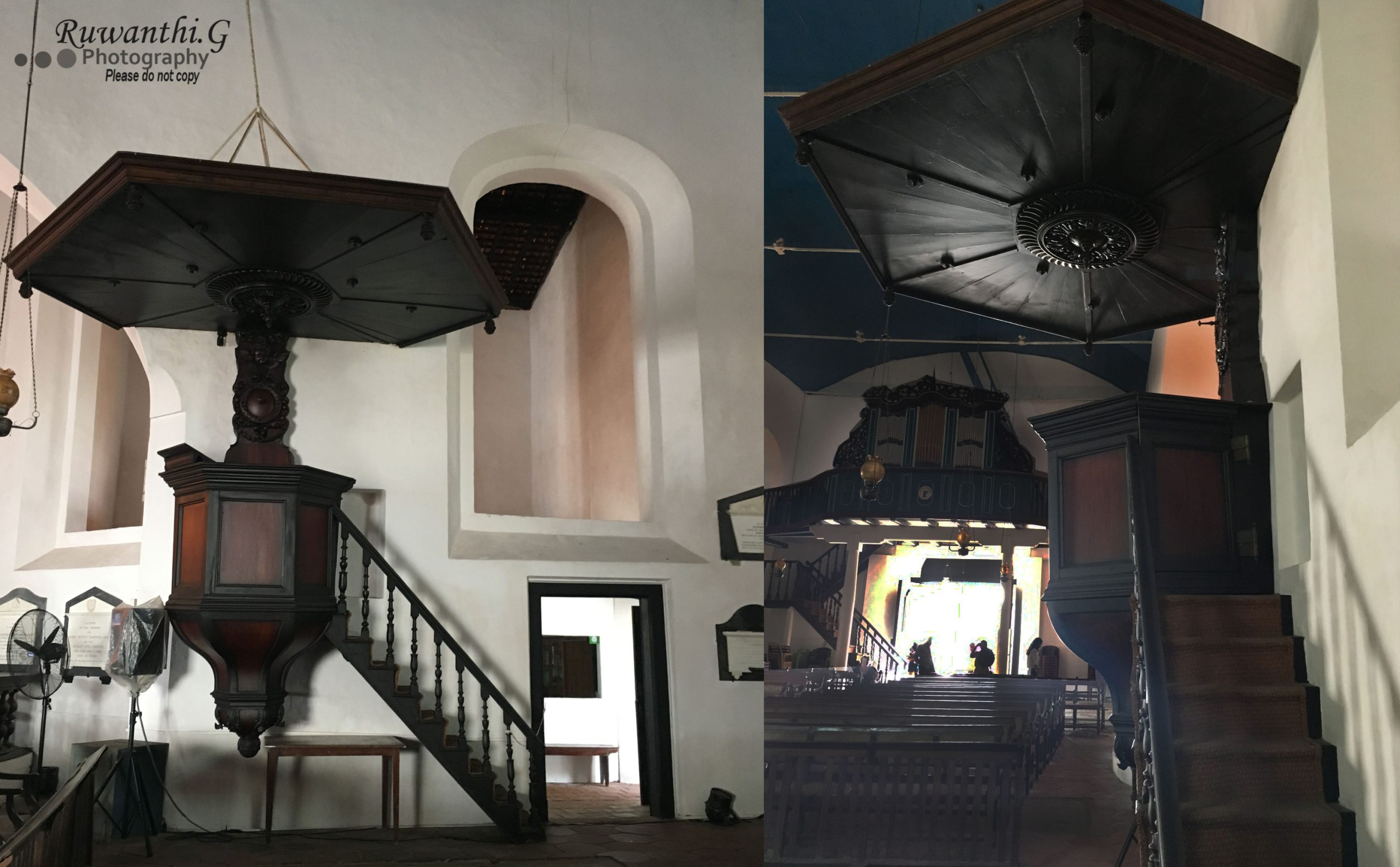
Unfortunately, the Original Ornate Organ, which was installed in the organ loft around the 1760’s is lost. A large stained glass window was added around 1830 and is still in good condition. Of particular interest is the beautiful hexagonal wooden Pulpit made of calamander wood with the panels on the side made of satin wood. Underneath the platform of the pulpit one can see a pomegranate pattern exquisitely carved. There is a huge sounding board suspended from the wall with huge iron rods and hoops.
riam

If you look down at the floor you will find tombstones of many European Colonist who died here in Sri Lanka, the walls too have many tombstones. On the walls are several inscriptions of baptisms, births and marriages.
It is said that there are underground tunnels running from this church to the Governors House.
Time required – Half an hour
Entrance – Free
Open – 8.30 am – 5.30 pm (Except during services)o, mea aperiam

THE DUTCH WAREHOUSE
The Dutch warehouse is the yellow colour building in the Eastern part of rampart and which forms part of the rampart itself. The main entrance was through the middle of this building. This warehouse was used to store spices and other items ready to be shipped to Holland every year. It is a two storied building with interesting windows. Although you cannot go inside it has a beauty in itself. The National Maritime Museum is housed inside this warehouse.


THE LIGHT HOUSE
This light house is the oldest Light House in Sri Lanka, built originally in 1848. It is built on the Southern most end (Point Utrecht Bastian – Utrecht by the way is named after a large town in Holland) and was been build 6 meters ( 20 feet) above road level and it has a magnificent view of the ships that enter the Harbour. A strategic location to spot any unwanted ships entering Galle.
The original Light House was destroyed in a fire in 1934 and was rebuilt by the British five years later to a height of 26 meters (87 ft) (It was earlier 24 meters ie. 80 ft). It was rebuilt at a spot further away from the original.


In the original light house, the light was a glass prism lens which floated in a bath of Mercury, to reduce friction, and was driven by a special weight driven machine. Today, the lights are operated by computer and automatically comes on in the evening and goes off at dawn.
Interestingly, if you have spotted that curious looking door way under the light house which can be seen from the road, that is the Dutch ammunition magazine warehouse, upon which the light house was later built.
If you wish to climb the light house, you may find the lighthouse keeper at the Gem store nearby.
DUTCH Clock tower and Ramparts
This clock tower was built in 1707 and this is the ideal place to get a feel of what the Galle Fort was like. This is said to be the area where the slaves were held in captivity. There are a few statues constructed which show what it was like in those days. It depicts the soldiers, slaves and traders. You can peep through the sentry points and imagine that you were a sentry looking out for invaders. You can see the city far below.


Ramparts
There are two main gates into the fort. The walls in the front was built by the Portuguese. Later when the Dutch invaded they reinforced the walls by building several Bastions called Sun Bastian, Moon Bastian, Star Bastian, The Aurora Bastion, Tremon Bastion, Kleipenberg Bastion and the Emaloon Bastion.


At one of the entrances just over the arch, there is a British logo and inside the entrance there is a VOC logo of the Dutch East India Company.
At the other gate there are two lions and a cockerel guarding it. This dates back to 1669.
The Dutch also constructed roads inside the Fort and they devised a sewage system which carried all the sewage in the fort to the sea by gravity using the high tide.

Sometimes if you are kucky you can even watch the snake charmer blow his pipe and while he does so the lid of the old reed basket open slowly as if by itself and soon it will reveal a snake! As he blows his tune the snake will do a small dance. After which, he will ask the brave to stroke the snake. Of course he expects you to place some money for this display.


Location – On close to the main entrance
Entrance – Free
Opening Hours – all day
You could also watch a monkey dance by another person who often sits there and stroke the monkey too. I think it’s a much safer option than the stake! Just drop a few notes as a gesture of thanks. These people are economically in the lowest strata of society and earn their living by this show. I think its way better than begging or getting into mischief. You are actually helping them and their families to live and not go hungry.
The Library
Whether you are interested in reading or not, this simple Library is a place one must visit, it was built by the Dutch between 1638 and 1796 and has some very rare and old books and documents dating as far back as to 1832. There are also some beautiful photographs of the Colonial era, which is very interesting. It is also said to be the very first library of the country. There are some very comfortable armchairs that you can relax on to read and some old Dutch furniture scattered around.


Originally the building was used as the official residence of the Post Master General but later it was used by the soldiers of the Malay Rifle Regiment as a “Reading Hall”. It was later renamed by Governor Sir William Gregory in 1845 as the “Galle Library”. For the early part, the Dutch Colonials managed it until Dr. Peter David Anthony became its First Sri Lankan President. He was a member of the British Medical Association, it was later also managed by Dr. CWW Kanangarara who was the originator of free education in Sri Lanka.
There are about 8000 books in the library at present in all three languages and has some very rare books including the book “An Account of the Island Ceylon” by Robert Percival and “Description of Ceylon” by James Cobdiner. The Galle library was at one time a haunt for the lawyers to while away their time. Some people came here to read the newspapers. There are books on many different topics including books on Mountaineering, Fishing, Religion, Philosophy, Music, Theater, Photography, Pets and much much more. Many of the books were donated from its inception. In those early times it was the custom to donate a book as their support for membership.
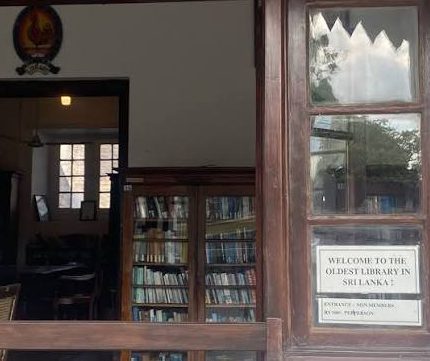

Interestingly, the membership to this library is very selective and not everyone who applies is granted membership. To be a permanent member of the Library you have to be a permanent resident of Galle. A selection committee of seven office bearers will sit to decide on membership. At the meeting, each member will be given a black and white ball and as the name of the applicant is read out they will take one ball covered in their fists and drop it into a jar. This is the casting vote. The black ball is a “no” and the white is a “yes”. Only if the decision is unanimous will the applicant be admitted as a member. If the applicant is given even a single black ball he will not be selected. No one can argue over the selection after the election.
MEERAN JUMMA MOSQUE
The architecture of this mosque is unusual and unconventional. It has a touch of Portuguese Baroque style to it. The Portuguese did not allow a Mosque to be built inside their Fort as they were anti-Muslim. However, the Dutch being more tolerant allowed the first mosque to be built inside in the 1750’s. It was later replaced by the present mosque in 1904. It is a mystery as to why this mosque was designed in this manner. Some believe that it was so built so as to not cause animosity with the Colonial overlords while others think that the Muslims at that time chose to adopt the architecture which was around at the time.
It is the tiny minarets and the Arabic writing on the top of the building on either side of the clock that shows any indication that it is indeed a mosque. Today, the people inside the Galle Fort live in harmony together and the Galle Fort is a multi-cultural place. You can go inside except during prayer time but make sure that you are attired properly and conservatively and act with decorum inside. Women, should check before entering and cover their heads and arms and legs. This I was told is done so that the men worshipping inside are not distracted from their worship. Even if you don’t go inside the mosque is indeed a beautiful building.
Location – Rampart Street
Entrance – Sometimes allowed. Check before entering
Time Required – Half hour

Dutch Hospital
This is one of the Oldest buildings in the Fort. A Portuguese Mint stood on this land before the Hospital was built. It was used by the Dutch government as a hospital for the Offices and other staff serving the Dutch East India Company. It also served Dutch sea farers as it was close to the harbour.
The Hospital which the Dutch built was a rectangular two-story building and it had long verandah’s with columns on both sides. The floor was of granite while the walls were first made of cabook (coral stone) and was later plastered and white-washed. The British expanded it and used glazed windows and fanlights. They also built and extension from the middle of the building towards the sea. The British converted it into a Barracks and they later used it as an office of the Government Agent who was the main administrator of the Galle District.


When Sri Lanka got its independence they used it as the Galle Town Hall and offices. Today it is used as a shopping Mall and dining area.
Location – Old Hospital Building, Hospital Street
Walk around the Fort
I love to simply walk around the streets of Galle Fort with my straw hat on my head and my shoes clicking on the stone paved streets. The streets are narrow and dip and climb and so full of interesting shops, restaurants and just things to see and observe. A new culture, a new life style and a new set of values. The Huge trees give you shade and the wind from the sea cools your body. Be ready for the unexpected.


You will find an old abandoned post office tucked away inside an old ochre building which has probably not changed since the Dutch left! Nip into the shops crammed with antiques from old gramophones and brass lamps to silver jewelry. Even if you are not going to buy it is a fascinating place just to give your eyes a feast.
You can peep into the houses of the residents which often has just a plain wooden door and a window in front but if you peep inside you will find it stretches endlessly with beautiful courtyards bursting with flowers.


There are some nice art galleries with beautiful sculptures and paintings if you love art. Shops selling Sri Lankan souvenirs, leatherwear and clothes are strewn in almost every corner.


You should particularly drop in at the Spa Ceylon shop where you will find natural beauty treatment products made from old Ayurveda recipes. Whether its face care, scrub, eye serums, masques, hydrating products or dosha treatment, they have it all. Its made from natural material and has the most wonderful smell.
You could also find strewn on a side of a verandah an ancient granite bath which was used in the years gone by as a medicinal bath. The streets are full of the unusual.

Law & Lawyers

Don’t forget to walk by the lawyers cubbies with their black and white boards hanging from the walls. Its unbelievable that they can actually work in such a small space! Most of them have probably not been painted since the Dutch left!!
The law courts also still in use here.

The buildings in the Galle Fort are clearly those of Dutch Origin with the typical pillars. They have now been declared a heritage site and they are not allowed to change its façade. The smaller streets where the poorer people live is also fascinating, walls with plaster fallen off exhibiting old bricks, clothes washed and hung out to dry in lines, children riding bicycles much too big for them and zig zaging on the roads and nearly knocking you over in their effort to keep the bicycle straight and themselves seated!! Pots being washed, foods being cooked, naked children being bathed under public taps and children sitting on door steps or peering from doors and windows is a normal sight here.


If you are lucky you may even find a man carrying Kidu in a freshly woven palm leaf basket. It is a famous dish of the Muslims. A rice dish. Do look out for it and try and taste some.
In the early evening, walk along the rampart, the thick wall of the Fort now covered with sand and grass in places. You will find interesting happenings. Often you get children playing and parents watching while some sea bath down below. I once spotted a little child plating her mums hair. Fathers clutching on to their children and taking in the fresh sea air.


Amost daily you will find a man selling pineapples. He will cut fresh pineapples and put them into tiny plastic bags and then add salt and chilli powder. It’s a favourite snack among Sri Lankans. Ice cream vans will attract the kids. And the kadala man is a hot favourite as is the chips and Isso wade sold by the man pushing a cart with glass windows tempting you to buy the tasty looking finger food inside. Have these only if it is fire hot or you have a strong stomach as it is not the most hygienic! When you are tired, buy a Thambili, the fresh orange coconut which they will cut then and there and pop a straw in and sip away while you wait for the sun to set.


A little bit of history of the Galle Fort
The earliest historic existence of Galle was found in Ptolemy’s World Map of 125 – 150 AD during which time Galle was a busy Port, used for trading with Arab Countries, Greece and China. Later in 1505, Lorenzo de Almeida, landed in Galle and struck up a friendship with the King of Kotte, Dharmaparakrama Bahu and later took over the area, which became the Galle Fort. Interestingly, it is said that Ibn Batuta, the Muslim scholar/traveller from Morocco who travelled the medieval world, had touched base at this port before the Portuguese arrived.


The Fort was first built by the Portuguese invaders in the 16 th Century, with Palm Trees and mud with a moat and was used to imprison the Sinhalese people who opposed them. The Portuguese called in Santa Cruz. Later they used it as a Fort to guard the Harbour and built a watchtower and three bastions. The Portuguese also built a Franciscan Chapel inside the Galle Fort in 1541.
In the mid 17 th Century, the Dutch helped King Rajasinghe II to capture the Galle Fort from the Portuguese but ironically the Dutch captured the Galle Fort for themselves and used it as an Armed Fort fortified with granite stones and coral and made it more secure. They moved the main entrance and had a moat around the Fort with a drawbridge. They built ten bastions – Star Bastion, Moon Bastion, and Sun Bastion etc.


They built public administration buildings, warehouses, and business houses as well as residential quarters. They also built a Protestant Church in baroque style for the Colonists and the converted locals. The Commandants residence, the arsenal and gun house were the main buildings. They also built an elaborate system of sewers, which flushed away the sewage into the sea when it flooded due to high tide at night. They also built storm water drains to prevent the Galle Fort from being flooded.
The British captures the Galle Fort in 1796. They did not make any changes to the Galle Fort except that they took the Dutch Coat of arms (with the VOC – Dutch East India Company inscribed), which was on top of the Main Entrance and relocated it to the back of the entrance and placed their own British Coat of arms in its place. Since the British ruled from Colombo, the Galle Fort had little significance to them.
